
DUST CONTAINMENT · NORTH SHORE
Dust Containment Floor Sanding on the North Shore
Our sanders send dust into a collection system right at the machine, and we wrap your kitchen cabinets before we start. Here is what that means for your family while the floors are being done.

Dust caught early
The Oneida Vortex DCS and Bona Portable DCS 2.0 collect dust where it is made.
Cabinets wrapped
Kitchen cabinets get clear plastic and blue masking tape before sanding starts.
A plan for home life
We tell you which rooms you can use and when you can walk on the floor.
01 / DUST CONTAINMENT FLOOR SANDING
Floor sanding that keeps dust out of the rest of your home
Dust containment floor sanding is a full sand and refinish done with sanders hooked up to a dust collection system. Instead of relying on a cloth bag on the machine, a hose carries the dust to a separate collector. Most of it is captured the moment the sandpaper lifts it off the floor, before it can drift through the house.
It makes sense for almost any refinishing job in a lived-in home, and most of all for families with young kids, pets, allergies, open kitchens or freshly painted walls. Homeowners in Wilmette, Glenview and Highland Park often tell us their biggest worry is not the floor itself but the mess. That is a fair worry, and it deserves a straight answer.
As part of our wood floor refinishing work, we handle the dust collection setup, cabinet protection, sanding, finishing and daily cleanup. Before we begin, we go over what to pack up, which rooms will be off limits and how long each step usually takes.
02 / DUST CONTAINMENT FLOOR SANDING
Is dustless floor sanding really dust-free?
No, and we will not tell you it is. Sanding a wood floor always makes fine dust, and a small amount can settle on nearby surfaces no matter what equipment is used. What a good dust containment system changes is the amount. Instead of a gray layer on every shelf in the house, you may find a light film near the work area that wipes right off.
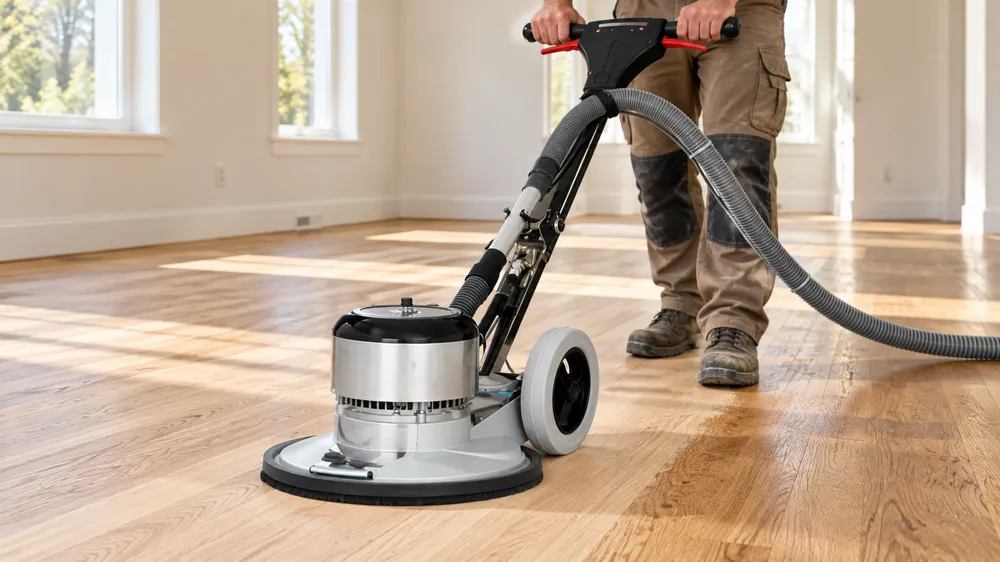
Our crew sands with the Oneida Vortex DCS and the Bona Portable DCS 2.0. Both are dust collection systems that connect by hose to the sanders. They pull dust away from the sanding drum and the edger and hold it in a separate container, which works far better than an open bag hanging off a machine. Less dust in the air also means less dust landing in the wet finish later.
The rest comes down to work habits: emptying the collectors before they get full, vacuuming between steps and keeping doors to unused rooms closed. If you want to know how we get the surface flat and smooth, our hardwood floor sanding page covers that part. If anyone promises you zero dust, ask what equipment they use and what happens along the walls and in the corners.
03 / DUST CONTAINMENT FLOOR SANDING
How do you protect my kitchen and the rest of the house?
Kitchens get extra attention, because cabinet doors, drawer fronts and open shelves catch fine dust easily. Before sanding starts, we wrap the kitchen cabinets in clear plastic and seal the edges with blue masking tape. The plastic keeps dust off the cabinet faces and out of the gaps around doors and drawers, and blue tape is made to come off cleanly when the job is done.
In the rest of the house, we close off the work area as much as the layout allows and keep the collectors running on every pass. We vacuum the floor between sanding steps and before every coat of finish, because a clean surface matters as much for the finish as it does for your home. At the end of each day, we leave the house tidy instead of covered in tools and debris.
- Clear plastic and blue masking tape over the kitchen cabinets
- Dust collectors running on the big sander and the edger
- Vacuuming between sanding passes and before each coat
- Cleanup at the end of every work day
04 / DUST CONTAINMENT FLOOR SANDING
What should we do to get the rooms ready?
A little preparation makes the job go faster and protects your things. We ask homeowners to empty china cabinets, drawers and shelving units in the rooms being refinished, and to put away fragile items, lamps, framed photos and anything valuable. If closets open onto the work area, clear the closet floor so nothing gets in the way and the edges can be sanded.
Our crew helps move the furniture, with your cooperation. We talk it through at the consultation: what goes where, which pieces are too heavy or too delicate to move with drawers still full, and where furniture can wait for a few days. Planning this ahead means nobody is scrambling on the first morning.
It also helps to plan your routine for the week. Think about where you will make coffee and meals, where the dog or cat will stay, which door you will use to come and go, and where the kids can play while the main rooms are closed. A simple plan makes the days much easier for everyone.
05 / DUST CONTAINMENT FLOOR SANDING
Can we stay home during floor refinishing?
Many families do, depending on the layout of the house and which rooms are being done. If we are refinishing the main floor and the bedrooms are upstairs with another way to reach them, staying home is often workable. If the only path to the kitchen or the stairs runs across the fresh floor, we plan the order of the rooms with you or suggest staying somewhere else for the finishing days.
Pets and kids need a plan for the sanding and coating days. Keep them in a closed room or out of the house so nobody runs across a wet coat. Pet nails can mark a fresh finish, so we tell you when the dog can come back onto the floor.
Finish smell is part of the process. Our crew explains ventilation and which rooms you can use, and you get instructions for your specific project. If someone at home is pregnant, has asthma or is sensitive to odors, tell us at the consultation so we can talk through timing. For any health question, please check with your doctor.
HOW IT WORKS
How a dust-controlled refinishing job works
Free in-home consultation
We look at the floors, measure with a laser and talk through rooms, pets, schedule and what needs packing up. You get a detailed written estimate.
Prep and protection
You empty cabinets and drawers and put away fragile items while our crew helps move furniture. We wrap the kitchen cabinets in clear plastic and blue masking tape.
Sanding with dust collection
We sand with the Oneida Vortex DCS or Bona Portable DCS 2.0 connected, vacuum between passes, apply the finish and clean up each day.
Final walkthrough
We walk the floor with you and explain drying times, when furniture can go back and which care and cleaning products to use.
BEFORE YOU BEGIN
Your questions,
answered.
Have a question about your floor? We can review it during your free estimate.
(847) 781-0100How long until we can walk on the floors and put furniture back?
Light foot traffic, such as walking in clean socks, is usually fine after about two hours once the last coat goes down. Furniture can usually go back after about two days. These times depend on the finish system, the temperature and humidity in the house and how many coats were applied, so we give you exact instructions for your project at the final walkthrough. When furniture goes back, lift it into place instead of sliding it, and put felt pads under the legs. A full sanding and refinishing job usually takes about four working days from start to finish.
Which rooms can we use while you are working?
Any room that is not being sanded or coated is yours to use, as long as you can reach it without crossing the work area. On many North Shore homes that means the upstairs bedrooms stay open while the main floor is done, or the other way around. In homes where everything connects through one hallway, we can sometimes split the work into sections so you keep a path open. We go over this room by room at the consultation, so you know ahead of time which days the kitchen, the stairs or the main entrance will be closed.
Do I need to empty my kitchen cabinets?
No. We wrap the kitchen cabinets in clear plastic and seal them with blue masking tape, so the dishes and food inside can stay where they are. The catch is that you will not be able to open those cabinets easily while the plastic is on. Before we start, set aside the plates, pans, snacks, pet food and coffee supplies you will need for the next few days and keep them in a room you can reach. China cabinets and freestanding hutches in the work area are different: those need to be emptied so the furniture can be moved safely.
Will dust get into closets, vents or other rooms?
With the collectors connected, most of the dust never leaves the sanding machines, and that is the biggest difference you will notice. Some very fine dust can still travel, so we keep the work area as closed off as the layout allows. It helps to keep closet doors shut and to clear the floors of closets that open onto the rooms being sanded. Tell us where your heating and cooling vents and returns are in the work area, and we will talk through how to handle them during sanding. At the end of the job we clean up so the house is ready to live in.
What does the written estimate include?
Your written estimate lists the work, the materials and finish products, the approximate start date and how long the job should take, so you know what to expect before anything is moved. Sanding with dust collection is how we refinish floors, and we explain at the consultation how we will protect your kitchen and the rest of the house. Our minimum service charge is $770, and we offer a 10% winter special and a 10% referral discount when the friend you referred signs. To get real numbers for your home, request a free in-home estimate or call (847) 781-0100.
LET’S TALK ABOUT YOUR HOME
Planning a refinish with the family at home?
Call (847) 781-0100 or text us a few photos, and we will talk through dust, rooms and timing at a free in-home consultation.