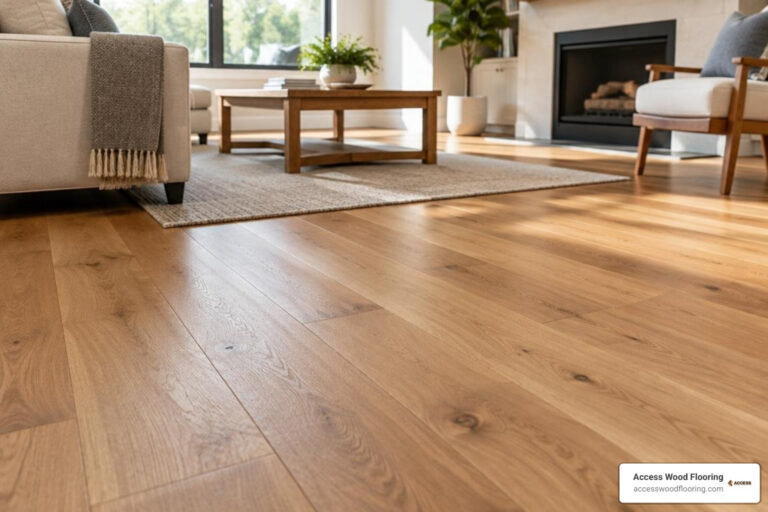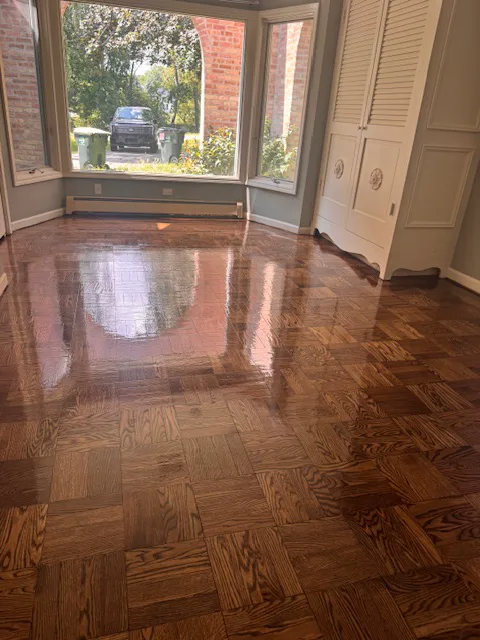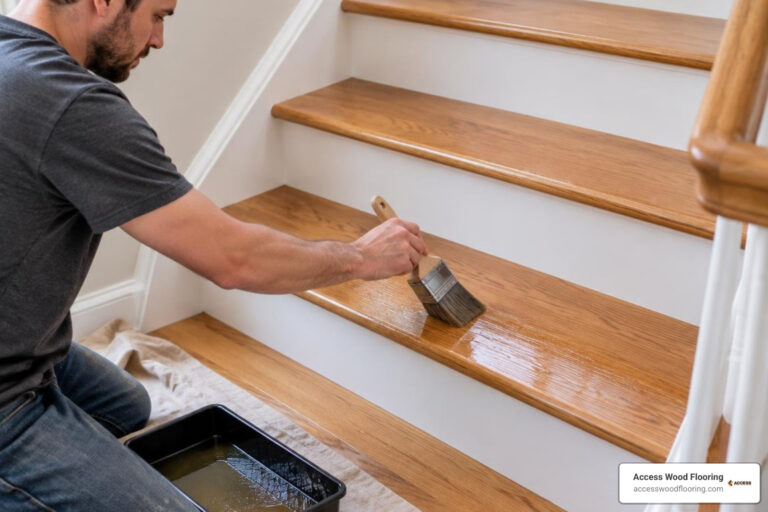
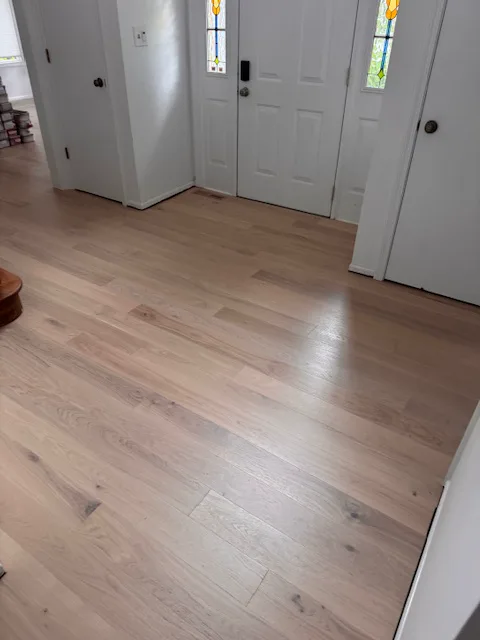
A 14mm engineered floor combines a real wood surface with a layered core that helps limit movement as humidity changes. Before installation, check the product’s wear layer, approved installation methods, and heating compatibility.
What Is 14mm Engineered Flooring Made Of?
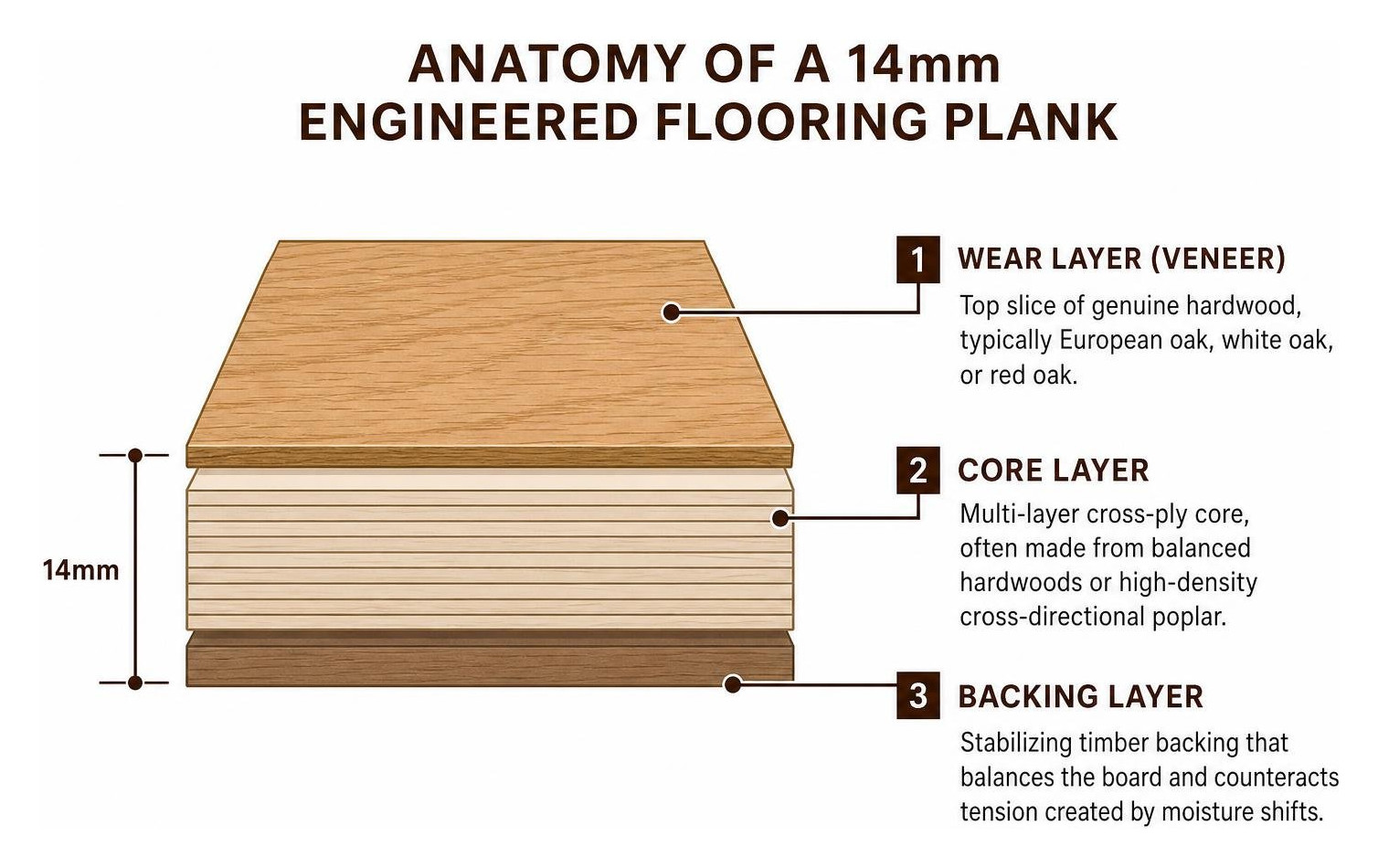
Engineered wood flooring combines a real wood surface with a layered core. A 14mm plank is roughly 9/16 inch thick.
The structure consists of three main components:
- The Wear Layer (Veneer): The topmost slice of solid wood. The wood species depends on the selected product.
- The Core Layer: Several wood layers, often hardwood or poplar, with the grain running in alternating directions.
- The Backing Layer: A wood backing that helps balance the board as moisture levels change.
When selecting products, environmental standards matter alongside dimensions. Look for Forest Stewardship Council (FSC) certification for responsible wood sourcing. For indoor air quality, FloorScore tests flooring for emissions of volatile organic compounds (VOCs). E1 is a formaldehyde-emissions classification. Neither means a product emits no harmful gases. The U.S. Environmental Protection Agency provides general guidance on indoor air quality.
Wear Layer Thickness and Refinishing Potential
Wear-layer thickness affects whether an engineered floor can be sanded. Total plank thickness does not establish refinishing potential. Check the selected product’s specifications and have a professional assess an existing floor’s remaining wear layer.
Homeowners often ask whether these floors can be sanded. Whether professional hardwood floor sanding is suitable depends on the floor’s construction, condition, and remaining wear layer. If the wood has minor surface wear or slight finish dulling, a safer option may be a professional screen and recoat. This process lightly scuffs the existing finish before adding a new coat. Aggressive drum sanding can burn through a thin veneer, so refinishing must be handled by an experienced professional.
Multi-Layer Core Construction and Stability
Solid wood expands and contracts across its grain as indoor humidity fluctuates throughout the year. In contrast, 14mm engineered planks use a cross-ply construction where each core layer runs perpendicular to the one above and below it.
The alternating grain directions help limit the wood’s natural movement. This helps as indoor humidity changes between dry winters and humid summers. The construction can reduce cupping (raised board edges), crowning (raised board centers), and gaps between floorboards.
How Does 14mm Flooring Compare With Other Thicknesses?
A 14mm board offers a middle ground between thinner 10mm flooring and thicker 20mm flooring. Underfoot feel depends on the board’s construction, installation method, and subfloor. Check how the total installed floor height will affect door clearances, baseboards, and transitions.
When choosing engineered wood flooring, compare the product’s construction and installation requirements rather than relying on thickness alone.
| Profile Thickness | Typical Wear Layer | Structural Rigidity | Installation Requirements | Refinishing Capability |
|---|---|---|---|---|
| 10mm | Check product specifications | Depends on construction | Follow product-specific requirements | Requires assessment of construction and remaining wear layer |
| 14mm | Check product specifications | Depends on construction | Confirm subfloor and heating approval | Requires assessment of construction and remaining wear layer |
| 20mm | Check product specifications | Depends on construction | Follow product-specific requirements | Requires assessment of construction and remaining wear layer |
Rigidity and Underfoot Feel
A 14mm board can feel solid when walked upon. Compare construction, installation method, and subfloor requirements rather than assuming a thicker board will feel more solid.
Some products have small angled edges called micro-bevels, while others have larger bevels or square edges. Beveled edges emphasize individual boards and can mask minor height differences between adjacent planks. Board widths and lengths vary by product; check the manufacturer’s specifications. If wet slip resistance matters for your room, ask for the selected product’s test results. Do not assume wire brushing provides a particular rating.
Hydronic Radiant Heat Compatibility
For underfloor heating, select a flooring product explicitly approved for your heating system. Do not rely on the plank’s 14mm thickness alone to establish compatibility.
Hydronic systems use heated water, while electric systems use heating elements. Do not assume a 14mm plank is approved for either type. Have the installer confirm compatibility and follow the flooring and heating manufacturers’ temperature limits and operating instructions.
What Does a Proper 14mm Engineered Floor Installation Require?
A proper installation starts with a flat, dry subfloor and an installation method approved for the product. Moisture checks and expansion space help prevent problems after installation.
Before opening any boxes, the installer must check the subfloor for flatness and moisture. The concrete or plywood subfloor must meet the selected flooring manufacturer’s flatness requirements. Dips must be filled with a leveling material, and high spots must be flattened. The installer should select moisture protection based on slab testing and the flooring and adhesive requirements. Expansion gaps around room edges and vertical obstructions must follow the selected product’s instructions. Professional hardwood installation helps ensure these flatness requirements and expansion gaps are maintained.
Direct Glue-Down vs. Floating Installation for 14mm Engineered Flooring
A 14mm board can be installed using two primary methods, depending on its joint profile:
- Glue-Down: The planks are bonded directly to the subfloor with an adhesive approved for the flooring and subfloor. The adhesive is spread across the subfloor with a trowel. Tongue-and-groove boards have projecting edges that fit into grooves on adjacent boards. The installer should confirm whether glue-down installation is approved for the selected product, heating system, and cabinetry layout. It reduces hollow tapping sounds and helps keep boards stable.
- Floating Floor System: This method often uses click-lock joints or tongue-and-groove joints with glue along the board edges. The floor sits over a sound-reducing underlayment beneath the boards without being attached to the subfloor. Floating allows faster placement, but it requires careful spacing around room edges and should not be trapped under heavy fixed furniture.
Acclimatization and Subfloor Moisture Management
Wood responds to its environment. Any required acclimation, or adjustment to conditions in the installation area, must follow the flooring manufacturer’s instructions. Run the home’s heating, ventilation, and air conditioning (HVAC) system to maintain the product’s specified indoor conditions.
For concrete slabs, the installer should test for moisture using a calcium chloride test, which measures moisture vapor released from the slab, or probes that measure relative humidity inside the concrete. Concrete must be fully cured and dry. If moisture readings exceed the installation system’s limits, the installer must resolve the issue and confirm an approved moisture-control approach before installation.
How Do Species, Grades, and Finishes Affect the Look?
Wood species affects grain and color, while visual grade determines how much natural variation appears. The surface finish changes the sheen and maintenance needs. If you want to change an existing engineered floor’s color, have a professional assess whether it is suitable for sanding and hardwood floor staining.

European Oak Grades and Color Variations
Engineered wood is sorted by appearance:
- Select or Prime Grade: Clean, uniform boards with minimal color variation and few, if any, small knots.
- ABCD Natural or Rustic Grade: Boards with more natural variation. This includes knots, variations in sapwood (the outer wood that is often lighter in color), subtle mineral streaks, and grain swirls.
Color options vary by product and can include cool grays, warm honey tones, and deep browns. Wire brushing removes the softer wood formed early in the growing season. It leaves a textured, low-glare surface that can make everyday scratches less noticeable.
Protective Finishes: Matte Lacquer vs. Natural Oil
The choice of finish affects maintenance needs:
- Matte UV Lacquer: UV-cured lacquer is a surface finish hardened with ultraviolet (UV) light. A low-sheen matte lacquer provides a natural look while offering resistance to everyday spills, scuffs, and dirt.
- Natural Penetrating Oil: Oils soak into the wood pores and highlight the grain. Oiled floors have a soft, low-sheen appearance, but they require periodic re-oiling to maintain protection.
How Do You Care for 14mm Engineered Flooring?
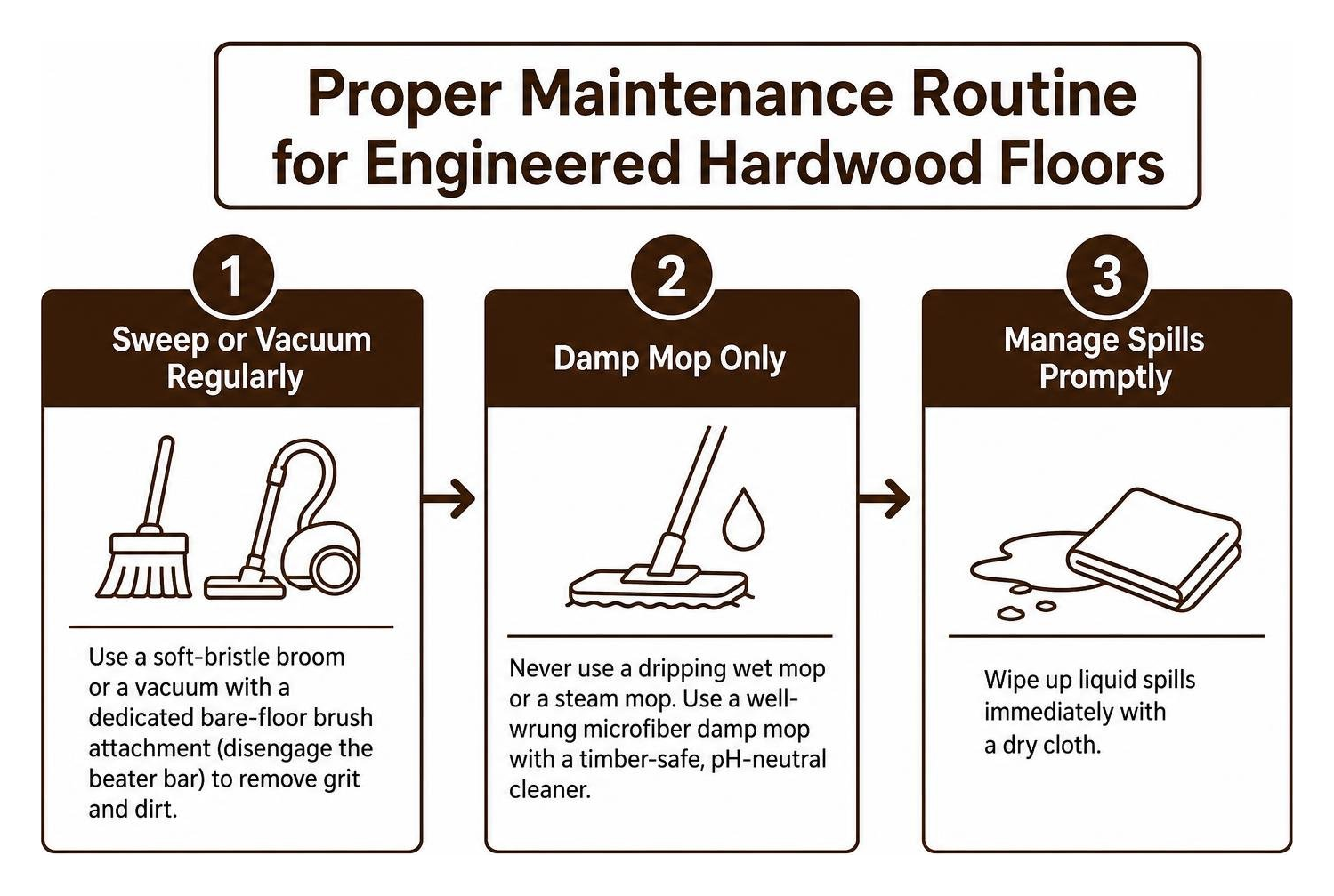
Engineered wood flooring is built for real-world living, but it is not waterproof. Remove grit regularly, wipe up spills promptly, and use only a well-wrung damp mop.
Routine Cleaning and Moisture Control
- Sweep or Vacuum Regularly: Use a soft-bristle broom or a vacuum with a dedicated bare-floor brush attachment. Turn off the rotating beater bar to remove grit without scratching the finish.
- Damp Mop Only: Never use a dripping wet mop or a steam mop. Steam can force moisture into board edges, causing finish peeling or core swelling. Use a well-wrung microfiber damp mop with a wood-safe cleaner with a neutral pH, meaning it is neither acidic nor alkaline.
- Manage Spills Promptly: Wipe up liquid spills immediately with a dry cloth.
- Use Protective Pads: Attach dense felt pads to all chair and table legs. Place breathable entryway mats at exterior doors to trap dirt and moisture before it reaches your wood floors.
Long-Term Maintenance for 14mm Engineered Flooring
Over years of use, high-traffic pathways may show slight surface scuffs. Before the finish wears through to bare wood, a professional buff and recoat may refresh it. Light screening scuffs the existing finish before a fresh coat of commercial-grade water-based finish is applied. The work typically takes about one day. For deep scratches or color changes, a professional should assess whether the remaining wear layer can safely undergo complete wood floor refinishing.
What Else Should You Know Before Choosing 14mm Engineered Hardwood?
Check the product’s wear layer and heating approval before choosing a floor. Installation cost depends on the subfloor, installation method, and room layout.
Can a 14mm engineered floor be sanded and refinished?
Possibly. A professional must assess the floor’s construction, condition, and remaining wear layer before recommending sanding. Screening and recoating may be suitable when the existing finish is compatible and has not worn through; timing depends on wear rather than a fixed schedule.
Is 14mm engineered wood compatible with electric underfloor heating?
Compatibility depends on the specific flooring and heating system. Have the installer verify the manufacturers’ approval and temperature limits before selecting a plank for electric underfloor heating.
What factors influence the cost of a 14mm engineered wood installation?
The cost of an engineered wood installation depends on several job-specific factors:
- Subfloor condition (leveling, grinding, moisture barrier application)
- Installation method (floating with underlayment vs. direct glue-down with adhesive)
- Room layout and architectural details (closets, hallways, stairs, custom transitions)
- Removal and disposal of existing flooring
Having a professional evaluate your subfloor in person helps establish a clear project scope.
Is 14mm Engineered Flooring Right for Your Home?
A 14mm engineered floor can be a practical choice when its wear layer, installation method, and radiant-heat approval suit the room and subfloor. Compare the manufacturer’s product specifications before selecting a plank.
Access Wood Flooring is a family-owned hardwood flooring company founded in 1996 and based in Hoffman Estates, IL. The company serves homeowners on Chicago’s North Shore and in the northwest suburbs with laser-measured, free in-home estimates and written project scopes.
For a free in-home written estimate for engineered hardwood flooring, request an estimate from Access Wood Flooring.